
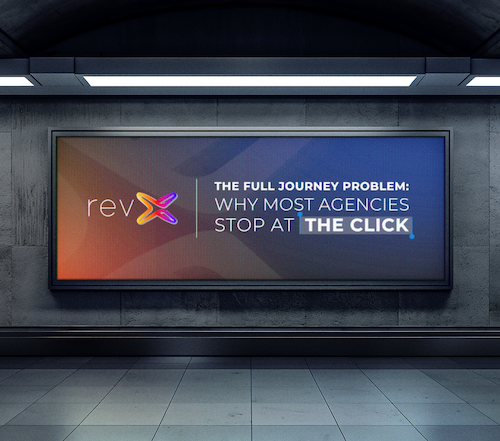
Henri Bam, Chief Product Officer at revX, says there is a moment in almost every campaign debrief where the numbers look good and the room still feels flat. Impressions were up. Clicks were strong. Cost per lead came in under target. And yet, somewhere between the dashboard and the sales floor, the optimism quietly evaporates. This is the full journey problem and it is one of the most expensive blind spots in digital marketing today.
Where Most Campaigns End
The architecture of most performance marketing campaigns is built around a single moment: the click. An ad is served, a person responds, a form is filled. The lead enters a CRM, a notification fires, and from the agency’s perspective, the job is done. The report gets written, the results get shared, and the cycle begins again.
This model made sense when digital advertising was simpler and measurement was harder. But the tools available today make it entirely possible to track what happens after the click and for most campaigns, what happens after the click tells a very different story than the dashboard does.
The gap between leads generated and revenue produced is rarely a mystery. It is usually a combination of lead quality issues, friction in the conversion process, poor follow-up timing, and a fundamental misalignment between what the campaign was optimised for and what the business actually needed. The problem is not that these issues are hard to solve. It is that most agencies aren’t structured to solve them, because their accountability ends at the click.
The Intent Problem
Not all leads are created equal, and the difference between a high-intent lead and a low-intent one is not always visible in the data that agencies typically track. Click-through rate does not tell you whether the person who clicked was genuinely interested or accidentally engaged. Cost per lead does not tell you whether the person who submitted a form had any real intention of buying. These are intent signals, and they live downstream of where most campaigns are measured.
When a campaign is optimised purely for volume, more leads and lower CPL, the system rewards behaviour that produces those numbers, regardless of what those leads are actually worth. Audiences get broadened to hit targets. Creative gets softened to maximise reach. CTAs get simplified to reduce friction. All of these decisions can improve the numbers on a report while quietly degrading the quality of what is actually being delivered to the business.
The result is a pipeline full of leads that look healthy in aggregate and perform poorly in reality. Sales teams spend time chasing people who were never going to convert. Close rates fall. The campaign gets blamed. And the cycle repeats.
What The Full Journey Actually Looks Like
Solving the full journey problem requires rethinking where a campaign’s responsibility begins and ends. It means asking not just how many people can be reached and moved to act, but what happens to those people once they have acted, and whether the system around them is set up to turn that action into revenue.
In practice, this involves several layers that most campaigns do not address.
Creative needs to be built around intent, not just response. An ad that attracts genuinely interested people looks and feels different from one built purely to generate volume. The audience targeting needs to reflect who is actually likely to convert, not just who is likely to click. The landing experience needs to continue the conversation the ad started, rather than presenting a generic page that breaks the connection between the promise and the delivery.
Beyond the front end, the lead management process matters enormously. How quickly a lead is followed up with changes conversion rates significantly. Whether a lead is validated before reaching a sales team determines how much time gets wasted on low-quality contacts. Whether the person who submitted a form receives any immediate acknowledgement affects how warm they remain by the time someone calls. These are not marketing details, they are conversion levers, and they sit in the gap between the click and the close.
The Measurement Shift
Fixing the full journey problem also requires fixing how campaigns are measured. When the primary KPIs are impressions, clicks, and cost per lead, the campaign optimises for those things. When the primary KPIs include conversion rate, cost per acquisition, and revenue generated, the entire system changes. Creative decisions get made differently. Audience choices get made differently. Budget allocation gets made differently. And the relationship between the agency and the client shifts from a reporting relationship to a results relationship.
This is not a small change. It requires agencies to take on accountability that most have historically avoided, and it requires clients to provide data, sales outcomes, close rates, revenue per customer, that most have historically kept separate from their marketing conversations. But it is the shift that closes the gap between what a campaign reports and what a business actually experiences.
The Cost Of Stopping At The Click
The most important thing to understand about the full journey problem is that it is not a niche concern for large enterprise clients with complex sales processes. It affects any business that runs paid digital advertising and measures success by lead volume rather than revenue outcome. It is common in insurance, automotive, financial services, and telecommunications, categories where the path from lead to customer involves multiple steps and significant drop-off, but it shows up everywhere that click-based metrics are used as a proxy for business results.
The cost is not just wasted budget, though that is significant. It is also the compounding effect of making decisions based on inaccurate data. If a campaign appears to be working because the leads are coming in, more budget flows toward it. The creative that generates volume gets scaled, even if that volume is not converting. The audiences that produce cheap leads get expanded, even if those leads do not close. Over time, the entire marketing strategy gets built on a foundation that does not reflect reality.
The fix starts with a simple question that most campaign briefs don’t ask: what does success look like after the click? The businesses that answer that question and build their campaigns around the answer are the ones that find the gap between marketing spend and revenue finally starts to close.
RevX
https://www.revx.ai/